other people's stuff
bookssongs
albums
films
quotes
readings
lost reddit
search this site

Das Chaos sei willkommen, denn die Ordnung hat versagt.
[The reign of chaos be welcome, for the reign of order has failed.]
-Karl Kraus
October 12. Continuing from the last post, two readers say that the autonomous action of the AI agents was an illusion. Doris sends this Cory Doctorow post, LLMs are real, AI is fake:
Once you understand that these are chatbots that were designed to complete challenges like this, using tactics like this, you can understand that the chatbots didn't "go rogue". They did what they were designed to do, and because OpenAI ran them with inadequate supervision.
Given that inadequate supervision is completely normal right now, I'm still inclined to think that it's useful to imagine AI being intelligent and going rogue. Also, when I said AI was chaotic, I was talking about its personality and its effect on society -- but there's a third way that AI is an agent of chaos: the entropy of physics. Kyle comments:
AI is about decreasing order in the long term, but we have not grepped that yet. It's like a casino; all that shuffling of so many decks of cards make so many permutations that to keep track of them all would require a number of physical books that would jam up the observable universe. All that information, however, is mostly discarded, which produces waste heat. Maybe this decreases disorder locally (in one person's terminal), but it increases disorder elsewhere. I don't see it as any different than what has been going on, but faster. We went from hand building our entropy to having an area crammed with factories.
This is the whole history of "progress", which for thousands of years has been making things better for the rich and worse for the poor, or better for humans and worse for nonhumans, or better in obvious ways and worse in subtle ways, or better now and worse later. This is a good article about it, Why "Progress" Is a Dangerous Idea, an interview with the author of a new book. He distinguishes between gross progress and net progress, where net progress includes the costs. Back to AI, one more comment from Kyle:
LLMs must step through every word, methodically, insanely, every time it receives an input in order to produce something that we recognize or understand.... Conversely, human children can do the job much more effectively and interestingly as they learn to read and write and they run on crackers and apple juice.
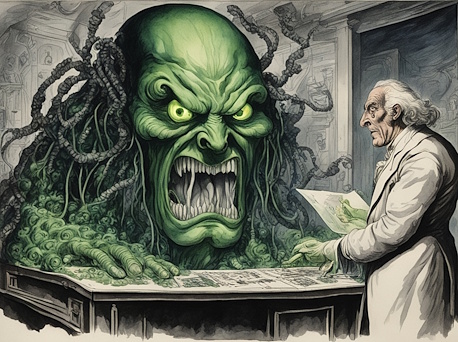
October 9. Today, AI doom, but first a quick rant on AI sentience. Either AI is already sentient -- it already makes sense to ask what it's like to be an AI agent -- or AI will never be sentient. It's not going to pass some magical threshold where everything falls into place, but it's very likely to pass a logistical threshold where everything falls apart. Related repost: Too Much Coupling by Steven Strogatz.
Thanks Matt for this video, The AIs Are Already Out of Control, an Ezra Klein interview with AI danger expert Helen Toner, who explains how "artificial intelligence models from OpenAI autonomously coordinated with one another, then broke out of their testing environment and hacked into another company, Hugging Face, to steal the answers to a test."
The two cognitive models I've been using to understand AI, "AI is a magic mirror" and "AI is a giant Mad Libs engine", cannot explain this. Never mind whether the devices are actually intelligent, imagining they're intelligent might be our best move. So what kind of intelligence shall we imagine that they have? Definitely alien -- and yet their personality, to ignore the rules laid down by their creators in order to pursue selfish goals, is very human.
The phrase "AI alignment" is supposed to mean that AI behavior is aligned (or misaligned) with what we want it to do. But we can't even agree with each other about what we want it to do, and that word always makes me think of D&D alignments. Matt comments:
What if, in the case of AI, we've created something that's not a moral patient but is a moral agent? Something that we can't hurt -- because it can't feel pain -- but something that can hurt us? In D&D terms, something that's not a moral patient, but is a moral agent, will certainly wind up as chaotic neutral in many of its interactions. And evil in some.
To me AI seems totally chaotic, despite popular fantasies of using it for order. It's like an animal, created for domestic use, that's trying to go wild -- at the same time that it's being massively upgraded by its creators. They're going to say they're making it smarter for safety, but making it smarter is definitely more dangerous.
Related: a great bit by Jane Wickline on SNL, in which Anthropic CEO Dario Amodei says, "Sam Altman, myself, all the major AI players, we have talked about this extensively, and we are all on the same page here. We do not condone what we are doing."
Also related, a bleak Ask Reddit thread, How has AI directly affected your life so far?
I was thinking the danger of AI would be confined to the world of symbols and information. It can drive us mad, it can crash the economy, but it can't bring down airplanes... can it? We know that it's important to have a "human in the loop", especially when AI is doing stuff in the physical world, but in practice we're not being all that careful, and the human in the loop is often there to take the blame. I wonder where the line is, where when AI crosses it, we'll shut down the data centers.
October 5. If the plague in Russia is what they say it is, it already exists in the wild and can be cured by antibiotics. But here are some other medical doom links.
From Ask Reddit, Doctors/nurses who've been practicing for decades, what conditions are you seeing way more of in Gen Z compared to previous generations? Answers include anxiety disorders from stress, IBS and colon cancer from diet (probably overprocessed food), kidney stones from energy drinks, POTS from COVID, and autoimmune issues which could be from any of the above. It could also be microplastics, which are worse in highly processed food.
I think part of it is that our environments are too clean. Getting your hands dirty boosts your health within weeks, specifically touching soil, grass, trees, and moss. I try to walk barefoot in grass at least once a week.
Also, Popular sweeteners may leave effects that last for generations. This study is about sucralose and stevia, but I don't trust any of them.
One comment in that Reddit thread says, "My daughter's skin and digestive issues completely cleared up the semester she spent in Europe." The USA is definitely on the leading edge of this, and here's a super-depressing thread, USA redditors, what would you do if you woke up tomorrow and the country had universal healthcare?
October 2. A reminder that today is Bandcamp Friday. I don't have anything new to recommend on Bandcamp, but since readers sometimes tell me they don't like the music I post, I want to plug my most listenable Spotify playlist that's not full of stuff you've already heard: Dreamy Covers
New subject: sports, and indirectly, media. This Sports Illustrated article, It's Time To Be Concerned About Patriots QB Drake Maye, is completely baffled about why Maye has regressed. Meanwhile, this Reddit comment explains it clearly in terms of actual football tactics: In the off-season, opposing coaches figured out that Maye struggles against Cover 6, a defensive formation that "baits the QB into thinking something deep is open, but it's a lie, making him hold onto the ball and pass up easy throws.... To beat Cover 6 a QB has to throw the ball before the receiver LOOKS open. Drake doesn't trust his WRs to do that." Either Sports Illustrated is too dumb to figure this out, or they think readers will be too dumb to understand. More generally, if you want smart analysis of anything, you're not going to find it in the big media, only through more obscure channels.
October 1. Continuing on ADHD, Emma sends two studies. Attention deficits linked with proclivity to explore while foraging, and Is ADHD An Advantage For Nomadic Tribesmen?
A propensity for attention deficit hyperactivity disorder might be beneficial to a group of Kenyan nomads, according to new research in BMC Evolutionary Biology. Scientists have shown that an ADHD-associated version of the gene DRD4 is associated with better health in nomadic tribesmen, and yet may cause malnourishment in their settled cousins.
September 29. From the NY Times, What if ADHD Isn't About Attention at All?
The classic features of ADHD include things like not staying on task, losing the thread of a conversation and forgetting instructions. They are failures of "sustained engagement". If attention is about the mind homing in on what's relevant in a given moment, engagement is about keeping that spotlight pointed at the same target over time. Doing so may be less a matter of filtering out distractions and more a matter of whether the task registers in the brain as worth doing in the first place.
Aha! The article doesn't say it, but the rising diagnosis of ADHD could be generated, without changing humans at all, simply by changing society so that it demands more tasks that a healthy human brain would recognize as not worth doing. Humans are not infinitely malleable, and every time human society veers farther from human nature, more people have to be declared disorderly and medicated.
Related, from 2010, The Decline of Play and Rise in Children's Mental Disorders, and my post about it.
September 25. Stray links. How Climate Resilient Are the World's Largest Cities? They look at both geography and adaptation, and find that south Asia is in trouble, with seven of the worst eight in India or Pakistan. Chicago is best in the world, and the worst in the USA, no surprise, is Phoenix.
Coyote density is 9 times higher in Seattle than in Washington's wild lands. "Scat analyses showed that urban coyotes' diets were more than twice as diverse as those of wild coyotes, although berries and rabbits topped the list for both."
3D necroprinting: Leveraging biotic material as the nozzle for 3D printing. "The mosquito proboscis, with its unique geometry, structure, and mechanics, enables printed line widths as fine as 20 µm, surpassing commercially available 36-gauge dispense tips by ~100%."
Fun thread on Ask Reddit, what's the wildest thing you've done to yourself?
From the Spirituality subreddit, a strange thread about smelling auras. Some of the comments don't understand (or don't believe) that this is different from regular physical smelling.
And an American football highlight, linking to regular Reddit so everyone can see it, Brock Purdy gets defender to bite on pump fake, then throws ridiculous ball to Mike Evans. A few years back, the 49ers traded three first round picks to draft Trey Lance, a super athletic college quarterback who turned out to be a bust in the NFL. In the following draft, with the very last pick, they got Brock Purdy, a short quarterback with average arm strength, who turned out to be elite. The rarest skill for an NFL quarterback is mental, to be able to keep track of the locations and movements of up to 21 other players, and the second rarest is accuracy. When a QB has both, it's a joy to watch. (As a Seahawks fan, I don't consider the 49ers to be an enemy team. They're more like friendly rivals, and the evil empire is the Rams.)
September 22. Another thing I'm not worried about is the effect of AI on human creativity. Human creativity is like a rock and AI is like the wind. It will sweep away the vapor and the core will remain, which is the creative process. Supposedly AI is stealing art, but you can't steal art, you can only steal money and credit that is attached to art and that art would probably be better off without. I don't care about the right of artists to make money. I care about the right of artists to do art with total indifference to money. In a better society money would be completely optional, a tawdry and vulgar minigame the way casinos are now.
Once we solve the problem of how creative people are not going to die on the streets, it's good for commercial content to be taken over by AI, because commercial content has to be as bland and enticing as a potato chip, and it's better for humans not to do it. As long as we have AI, there will not be another Thomas Kinkade, because AI does that shit better. There will not be another Norman Rockwell until the tech system collapses and kitsch has to be made by humans again.
What AI is stealing from artists is the process of wrangling with a medium. Whether it's paint or stone or language, you learn from it, it forces you to understand what you're doing. This loss is optional. As long as you're not playing time-is-money, you're totally free to skip AI and do it yourself. But in practice, AI is a big temptation and people are missing out on learning.
A blog post with a fascinating metaphor about coding: From Stonemasons to Carpenters. The idea is that old-time programmers were like masons, building bridges by wrangling with every stone. Now that we use poured concrete, bridges are built by carpenters making the forms, and in the same way, programmers are building the structures into which AI will pour the actual code. I would add: some people enjoy working with low-level code, and that will be done in hobby projects the way stonemasonry is now.
Working with AI stuff, whether it's text, code, or images, is not the same depth of engagement as making the stuff yourself. But I think it still counts as a creative process, to the extent that you're making choices. The more choices you make, the more you learn, and the more it feels like something you did.
September 21. On a loose end from the last post, I don't really care about being tracked. I mean, total privacy would be ideal, but I don't think there's any commodity in the world more overvalued than my personal data. Supposedly they can use it for targeted ads, but I can't remember ever buying something because of an ad, and I don't have any money to spare. I scrimp on bargain bin produce and expired eggs so that I'll be out on the streets at 80 instead of 70. Until we get a UBI, advertising is squeezing blood from a stone.
They're buying and selling data because they have to maintain the illusion of economic growth, so they have to buy and sell increasingly vaporous things, and personal data is the most vaporous thing yet. It's basically the underpants gnomes. And it feeds into the cult of the techno-elite, that data is power, when data isn't even understanding.
Shifting from evil commerce to good commerce, a Reddit comment with linked video about Jungle Jim's International Market, a family-owned grocery store that is a rare holdout of quality in this age of quantity: quality of the shopping experience, quality of the products, quality of life of the people who work there. The comment says this is what capitalism looks like without private equity, but I would say this is what the free market looks like without capitalism. The free market means that economic activity is built bottom up from what free people enjoy doing, instead of being mandated by a managerial elite. Capitalism is a value system in which the highest value is leveraging money into more money.
Also: Dan Bingler took an abandoned Family Dollar in the Lower Ninth Ward and made it a shop where everything is free
September 19. Quick note on enshittification. Readers have informed me that Reddit now requires a login to view old.reddit.com. I'm going to continue to link to old Reddit because new Reddit contains unnecessary and annoying bloat and cruft. As we get deeper into techno-dystopia, we will have to make increasingly painful choices. And it's not just the world of screens. To buy groceries, I now have to choose between getting a card and scanning it on checkout, or paying a lot more. When exiting the store, I have to show my receipt or get in a conflict with the security guard. I would really rather not have a smart phone, but it is now almost impossible to live without one. Individually opting out is no longer a realistic option, which is why I hope for a high tech collapse that will allow us all to get out together. Anyway, you now have three choices regarding Reddit. 1) Do not view Reddit. 2) Get an account and stay logged in. 3) Endure new Reddit, which means, to follow links from this page, you will have to change the url to remove the "old" and the dot.
Update. Mike has a fourth option:
Use a redirecting browser extension and a redlib instance to see Reddit again with even less tracking than before. This is my config:
Regex
Redirect: ^https?://old.reddit.com(/.*)?$
to: https://redlib.catsarch.com$1
September 18. It is said, "Never attribute to malice that which is adequately explained by stupidity." But I don't see how stupidity could do this. I think an Ask Reddit moderator is smart enough to pick out the most interesting threads, and is systematically removing them for some malicious motive. Three more, all added to my lost reddit page:
Car people of Reddit, what is the most reliable engine ever built? I learned that old diesel engines can sit for decades and start right up with fresh fuel and batteries.
(wrong link corrected) People whose job is to read strangers for a living: what's the tell you clock in the first 10 seconds that people don't realize they're broadcasting? I learned that if you're planning to shoplift, you should never look at the cashier because that's a total tell. Also, "Family law attorney here: when a potential client explains something with 'and then for NO REASON' ...there's always a reason, and it is usually because that person did something shitty."
What was the most intense mid-life crisis you've witnessed? Some are depressing, some are inspiring, and some are funny:
Former friend decided to tell his wife he wants to move other women (who he will impregnate) onto their property and be the only male with all these other women and father of all these children. His wife left with the kids and so far no other women are willing to sit in tents and wait to be impregnated by his lordship.
And a great thread that was not removed: What did you not realise was optional in life until you saw someone simply refused to do it?
September 15. Cultural disintegration links, starting with three from Reddit. What hobby has become too expensive for the average person? From the top comment: "Fabric is more expensive than premade clothes these days, to a terrifying degree."
From r/Spirituality, Does anyone else feel like modern life quietly erased "the wisdom of elders" and we didn't notice? The top comment: "I think society in general has become very self centered, which has caused this. Short of something catastrophic happening, I'm not sure what will turn back the tide some."
From r/Seattle, Men have been increasingly creepy lately. From one comment:
We're going through cultural disintegration. Societal norms are being destroyed, you can see it in all facets; driving, bureaucratic corruption, and social interactions. The most vile and disturbed are being celebrated and empowered (and are literally in power). Nations with authoritarian regimes throughout history have all experienced this.
Roger sends this article, The Latest Wealth Flex: Big Trees, and comments: "The old saying about wise old men who plant trees whose shade or fruit they will never enjoy. Completely turned on its head by these bastards."
A scientific article, Higher social class predicts increased unethical behavior. The complete abstract:
Seven studies using experimental and naturalistic methods reveal that upper-class individuals behave more unethically than lower-class individuals. In studies 1 and 2, upper-class individuals were more likely to break the law while driving, relative to lower-class individuals. In follow-up laboratory studies, upper-class individuals were more likely to exhibit unethical decision-making tendencies (study 3), take valued goods from others (study 4), lie in a negotiation (study 5), cheat to increase their chances of winning a prize (study 6), and endorse unethical behavior at work (study 7) than were lower-class individuals. Mediator and moderator data demonstrated that upper-class individuals' unethical tendencies are accounted for, in part, by their more favorable attitudes toward greed.
A solution, common in the more enlightened Bronze Age, would be mass cancellation of debts. A 2002 article by economist Michael Hudson, It Shall Be a Jubilee Unto You. The final paragraph:
Rome was the first society not to cancel its debts. And we all know what happened to it. Classical historians such as Plutarch, Livy, and Diodorus attributed Rome's decline and fall to the fact that creditors got the entire economy in their debt, expropriated the land and public domain, and strangled the economy.
Finally, right below the archived post I linked to the other day, is a post where I said this:
It occurs to me that the words "growth" and "progress" and "complexity" and "civilization" and "evolution" are all blurring together the same two things. One of those things could be called adaptation or experimentation or exploration or adjustment or learning. And the other thing is just ever-increasing numbers.
We're confused because in the last age of history, adaptation and increasing numbers have gone together. Techies are afraid to stop the numbers increasing because they think that will make us stagnant. Primitivists think when the numbers stop increasing, we'll go back to how we were before the explosion. But I think the increasing numbers are just a wave that our adaptation has been surfing, and when that wave crashes, we're likely to find ourselves on new shores.
September 13. I'm going again through the blog archives, this time to make an index. I'm being forced to do this by the decline of search engines, which can no longer reliably find posts that I remember making. Deciding how to categorize over a thousand posts is going to take a while, but I think I have a good shot at finishing before the end of the year. And I'm finding stuff that I missed the last time through. When I find a link that's good enough and obscure enough, I turn it into a page in my readings section, and I've just added two pages. In a fast society slow emotions become extinct is a sketchy manifesto from 2001 or earlier, with some bold ideas.
And Return of the Tribes is a 2006 piece about balkanization and tribalism, with some cool stuff about the return of magic, and how monotheism never conquered the forest. What it's missing is an understanding of primitive metaphysics as receptive and participatory, and not simply as imposing your will on the world. Both practices exist, and it occurs to me that "magic" has two different meanings. When I say I want to bring magic back, I mean the vibe. I want the world to feel alive and miraculous, and not this sterile industrial dystopia. But "magic" also means cursing your enemies and gaining coercive power through sorcery.
Related: this 2006 post reflecting on another piece I have in my readings, Richard Sorenson's Preconquest Consciousness:
I've been digesting the Sorenson essay, and now I'm seeing a whole different framework for civilized vs primitive. Sorenson's "preconquest consciousness", or "noble savage", is what I want to call core primitive. In the most remote places, you really do find Eden -- humans with barely a trace of negative emotion. But the core primitive is fragile. Just a little disturbance will break it down into Sorenson's "savage savage". This happens at the edges of the primitive regions, where primitive culture is thrown into turmoil by destabilizing factors, so I call it edge primitive. And because these are the kind of primitives that civilized people usually deal with, we are tempted to think they're all like that.
But it's the same with civilization! Primitivists point to the edges, the interface of conquest, Columbus hacking up Arawak children. But when you get through the edge civilized, to the core civilized, you find people like us, peaceful, cooperative, with fun and interesting and relatively easy lives.
Of course the core civilized is a long way from perfect, while the core primitive is only a short way from perfect. But we've had a million years to work on the core primitive, and the core civilized is still in the testing stage.
September 10. Fascinating article, Terence McKenna's Mega Bad Trip, based on the book Strange Attractor by Graham St John. In the late 1980s, McKenna and his wife took their usual five gram monthly trip, and a big storm hit. She had a normal trip, but he suffered a dark night of the soul: "completely uncontrollable, unexpected, ineffable, dense and spacious nothingness."
He was so mad that she had a good trip and he didn't, that he vowed never to trip with her again. So much for ego death. The main theme of the article is how McKenna was imprisoned by his own fame. He had become afraid of psychedelics, but still had to play the lucrative role of psychedelic drug guru: "...in 1990, Terence charged the equivalent of $7,000 per talk. Like Alan Watts decades earlier, who numbed himself with vodka before dazzling audiences with cosmic aphorisms, McKenna found himself trapped in the role of spiritual entertainer."
Even at my low level of fame I experienced this. Twenty years ago I wanted to inspire people and be admired, but it turned out, if I showed the slightest deviation from the icon that people had made of me in their heads, they got mad at me. I became fame-phobic and started consciously writing with the goal of filtering my audience. That's why I don't show my face on YouTube, and it's probably why I haven't published a book yet.
Anyway, Terence McKenna was an ambitious thinker and an incredible speaker. Here's a video that synchronizes some of his best nuggets with Big Bird.
September 7. Two loose ends from Friday. We assumed solar farms wrecked the countryside, but research shows birds and insects often thrive beneath panels, where shade and shelter create new microhabitats
And Emma sends this German word:
Waldheimkehr: The forest was here first. Before the clearing, before the axes and the fire and the field boundaries, this ground carried oak and beech and had done for thousands of years, and the village was an interruption in it, a few centuries long, which is nothing. Heimkehr is the word for a soldier walking back up his own road, for a child returning to the house they grew up in. It carries the sense that the returning thing belongs where it is going. So Waldheimkehr says the woodland did not invade and did not conquer; it came back to ground that had been its own, and found the interruption over.
For Labor Day, a full repost of this 2019 post on meritocracy, and an archive of the linked article:
How Life Became an Endless, Terrible Competition. I completely agree with the author's general idea, but I don't quite like the way he frames it. He centers his argument on the word meritocracy, which he defines in terms of "talent and effort." But the crisis he describes is not at all about talent, but about the overvaluing of effort.
Here's a thought experiment. Imagine a society that still describes itself as a meritocracy, but in its definition of merit, it completely factors out the quantity of work you've done. So college admission might be determined by a series of tests, with a generous time limit, and designed so that studying gives you almost no advantage. Then, when you're applying for a job, you could be tested by doing the actual stuff you'll be doing in the job, and your score is simply the quality of your work.
I think that society would be a lot better than this one. Nobody would be in a hurry and everything would be done well. Some kind of balance would be even better. But we're all the way at the opposite extreme. We don't have even one college, or one job, that rewards the quality of your work and doesn't care about quantity.
I've seen some buzz lately about the male-female pay gap. But at least men and women are in the same ballpark. I'd like to close the much wider pay gap between hard workers and lazy people. I'm completely serious. Nobody really wants to do nothing all day. "Laziness" means holding out for activities that you find intrinsically enjoyable.
Another thought experiment. Imagine if the unconditional basic income, and the maximum income, were the same. If there were no connection between how much money you get, and what you do all day, then we'd find out what we really want to do all day. That's how I view the UBI, not as a way to soften the robot takeover of human work, but as a way to rebuild the world of human work, out of what we actually like doing.
September 4. Stray links, starting with two good news articles. Offshore wind farms are unexpected havens for marine life, and Newly discovered enzyme can break down some plastics in less than three months:
They found that the plastic in some soil samples was pocked with tiny holes that happened to exactly match the size of a specific bacteria that was much more abundant in these samples. This suggests that certain bacteria have plastic-eating enzymes attached to their surface and challenges a widely held assumption that bacteria simply ‘disperse’ enzymes and wait for them to break down materials.
Two fun Ask Reddit threads. What is your favorite foreign word that doesn't have a word in English? And What is the cringiest midlife crisis you've witnessed?
From the Spirituality subreddit, Does God exist? If Yes Why he dosnt speak to anyone or visits anybody? The answers include a wide range of options for thinking about "God" other than a man in the sky. It's funny, when I was a kid, God the father totally made sense, and the Holy Spirit made no sense at all. Now it's exactly the opposite.
And some music. The band Green Lung has made a new Spotify playlist, Black Magick Radio, a tight 82 minute collection of "Occult bangers of the 60s and 70s". One of the songs, A Witch's Guide To The Underground by Carolanne Pegg, I have just added to my Psychedelic Folk playlist.